
Lee County Wanted Fugitives List
The Lee County Sheriff most-wanted page is the official public list for the county. Think of it as a tip interface. It is not a searchable certificate of every active or unserved warrant. The Sheriff posts updates on a routine basis, with no fixed day or hour, so the roster can sit empty one visit and fill in the next. When names do appear, each entry may carry an image plus a status marker, such as arrested or a recalled warrant, and all of it stays on the Sheriff's own page.
A listing can change before any web entry reflects it. Warrants get recalled, satisfied, paid, or modified, and the agency's page catches up at its own pace. So read the warning printed beside the official listing. The Sheriff says the information may not be current or accurate for a legal purpose, and it must never be the sole basis for action on your part.
Where the page earns its keep is focus. It gathers the Sheriff's wording, physical descriptors, and a direct tip route in one spot. What it cannot tell you is why a name is missing, or whether a person who shares a name is the person sought. The listing works best as a live agency notice. It works worst when it gets copied into a post, stripped of its date, or attached to claims about someone else.
Lee County Wanted Listing Fields
The county's wanted listing runs on a handful of identifiers. Names come first. Dates of birth and physical descriptors sit right beside them. Warrant numbers and charge descriptions fill out each entry, which makes it easier to narrow a search to one person. Blank fields pop up here and there. That usually just means the roster is being updated, and the missing detail tends to fill in later. Treat each entry as a pointer to a warrant on file rather than a settled fact about the person named.
| Field | What it can show |
|---|---|
| Name and aliases | The identity names used by the Sheriff entry. |
| Race, sex, hair, and eye color | Physical-description filters or details used to narrow a listing. |
| Last known location | A location associated with the entry, not a live location claim. |
| Wanted-for information | The stated warrant or charge basis supplied with the listing. |
| Bond amount | An amount displayed by the interface, which can change with court action. |
| Image or status marker | A Sheriff-hosted listing image or a status such as arrested or recalled when available. |
Check the name and every identifier before reporting anything. Similar names turn up constantly. An old address, a bond figure, or a photo from elsewhere is never current confirmation.
Lee County Wanted List Staleness
Lee County is blunt about its own limits. The list can go stale, the agency says, and is not treated as current for any legal purpose. Routine updating is not a live warrant feed. An entry may trail behind an arrest, recall, payment, court order, or correction by days or longer.
A fresh custody result and a wanted result answer different questions. Someone booked into the Lee County-Tupelo Adult Jail can appear on the current roster while the wanted list still shows the old entry. The two systems do not move in lockstep. And a wanted listing never means the person is in custody right then.
That gap matters most when the question is whether a warrant exists at all. The published list is a narrow public notice, not an answer. Only the agency can confirm a specific person's status. For the separate question of custody after an arrest, the county's official roster and booking-record paths are the right next stop.
Note: A name missing from the list proves neither that Lee County holds no warrant nor that an older entry is still active.
Use the Lee County Wanted List Safely
The Sheriff wants tips, not amateur detective work. Do not investigate, follow, approach, or try to apprehend anyone on the list. Open the official page and read the agency's current notice. If a recognition seems solid, report what you know. Let trained personnel handle the rest.
- Open the Sheriff’s most-wanted interface and read its current warning before relying on an entry.
- Use the available descriptors, aliases, and wanted-for information to avoid confusing people with similar names.
- Save only factual details that can help a dispatcher or tip reviewer, such as where or when a person was seen.
- Submit the information through the official tip route, call dispatch for a non-emergency report, or call 911 when there is an emergency.
The list is no substitute for a legal record either. Tips can be anonymous, but resolving a possible warrant is a job for an attorney or the court, not a web search.
Lee County Warrant Check Paths
No single Lee County portal lets the public search every warrant by name. Your first call belongs to the Sheriff's Office. The main line is 662-432-2600, with dispatch and non-emergency lines at 662-432-2622 and 662-432-2623. A dispatcher can point a live concern in the right direction, though only the agency itself can confirm a warrant's status.
The court side works through two offices. Lee County Justice Court handles justice-court matters at 662-432-2500, while the Lee County Circuit Clerk, located at 200 W. Jefferson Street in Tupelo, covers circuit and county court records at 662-432-2300. A docket may show a case or a hearing, but that is not the same thing as a full warrant-clearance record. Ask each office exactly what it can confirm and which agency holds the warrant.
Be plain about why you are calling. Is it a status question, a court-date question, or a question about which office issued the process? The Sheriff confirms what the agency holds. A clerk explains the case file and the calendar. Direct confirmation beats any web listing or secondhand report.
- Write down the exact legal name and any date, case number, or court information already known.
- Call the Sheriff for agency confirmation, then contact Justice Court or the Circuit Clerk when the possible matter is tied to that court.
- Ask whether a listed case is a court record, a warrant, or both, and ask what office can verify the present status.
- If a warrant may exist, consult an attorney or contact the court about a safe lawful resolution. Do not avoid contact with law enforcement.
Lee County Warrant Types
Warrant terms map onto different procedural paths. The office you need depends on which court issued the process. Knowing the vocabulary below helps a caller frame a clear question. It also keeps you from assuming that every docket entry is an active warrant.
| Type | Plain-language meaning | Check path |
|---|---|---|
| Arrest warrant | A judicial process authorizing an arrest on a stated charge. | Sheriff confirmation and the issuing court. |
| Bench warrant | A court-issued warrant, often connected to a missed required appearance or court order. | The issuing Justice, County, or Circuit Court and the Sheriff. |
| Capias | A court process directing that a person be brought before the court. | The clerk for the case and the agency that can confirm service status. |
Labels alone never tell the whole story. Bond, recall, service, and further court action can all change the outcome. A staff member can walk you through local procedure, and an attorney can advise on a specific situation. For the facts that matter most, go to the proper office. Ask about the issue date, the issuing court, and whether the warrant has been served.
Lee County Wanted Alerts and App
The Lee County Sheriff app is the agency's second official channel for public information. Its description covers wanted-person notices, anonymous tips, a jail-roster search, booking details, charges, and release status. Public-safety alerts, news, and contacts are in there too. It works well for announcements and a quick roster check. One caveat: it does not promise a public booking-photo feed. The official Sheriff app landing page shows the access point and the full feature list.
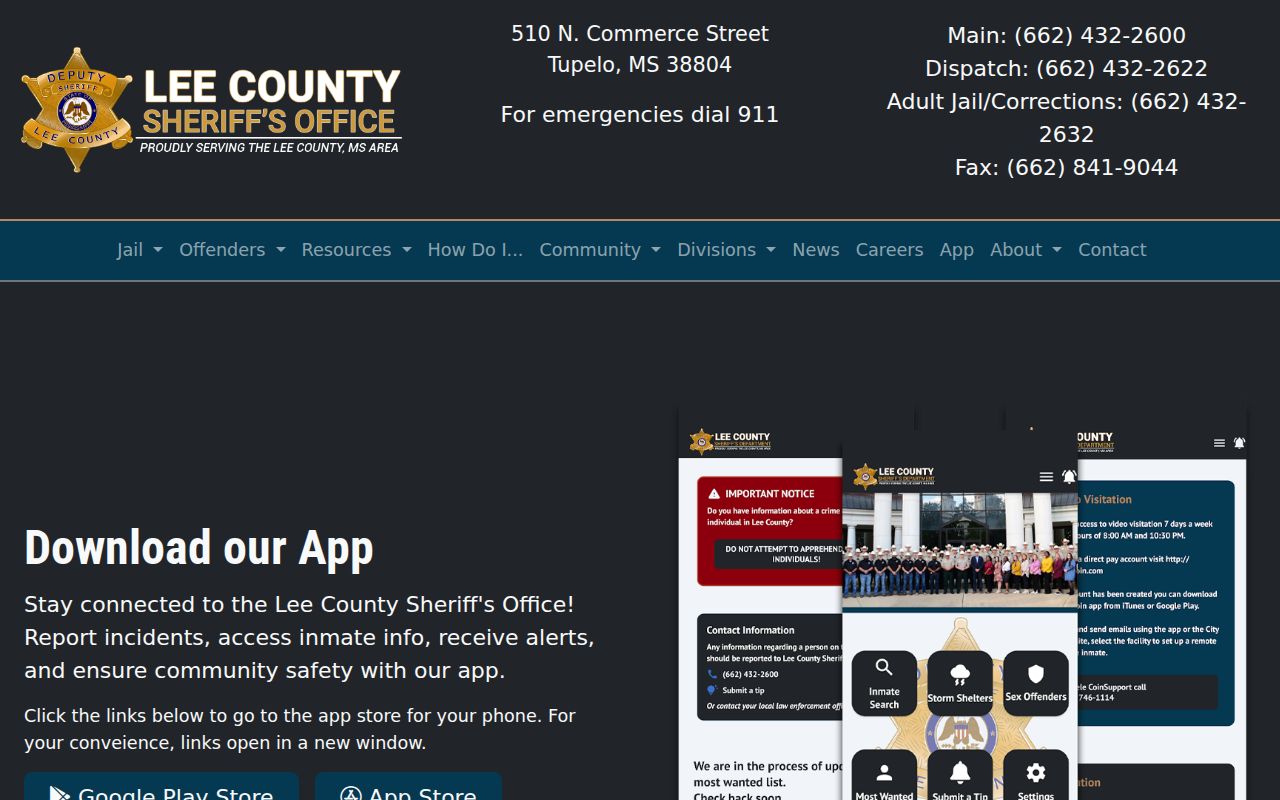
Software updates can change what the app displays. Treat any alert or screen as a lead. Confirm with the Sheriff or the issuing court before acting. Convenience is not a substitute for agency confirmation of a live warrant.
No verified Lee County Warrant Wednesday schedule exists. No reward amount has been published either. The confirmed alert feature is the app's real-time public-safety notification system, not a promised weekly warrant release.
Lee County Wanted Tips and Emergencies
The Sheriff's official tip form accepts anonymous submissions or requests for follow-up contact. It exists to pass information to law enforcement. One warning stands out: the form itself says not to use it for a crime in progress or an emergency. For an emergency, call 911. For a non-emergency report that still needs a prompt response, use dispatch at 662-432-2622.
Lee County Sheriff’s Office
510 N. Commerce Street
Tupelo, MS 38804
Main: 662-432-2600
Dispatch, non-emergency: 662-432-2622 or 662-432-2623
Emergency: 911
The official Sheriff tip form shows the safe reporting route available for wanted information.
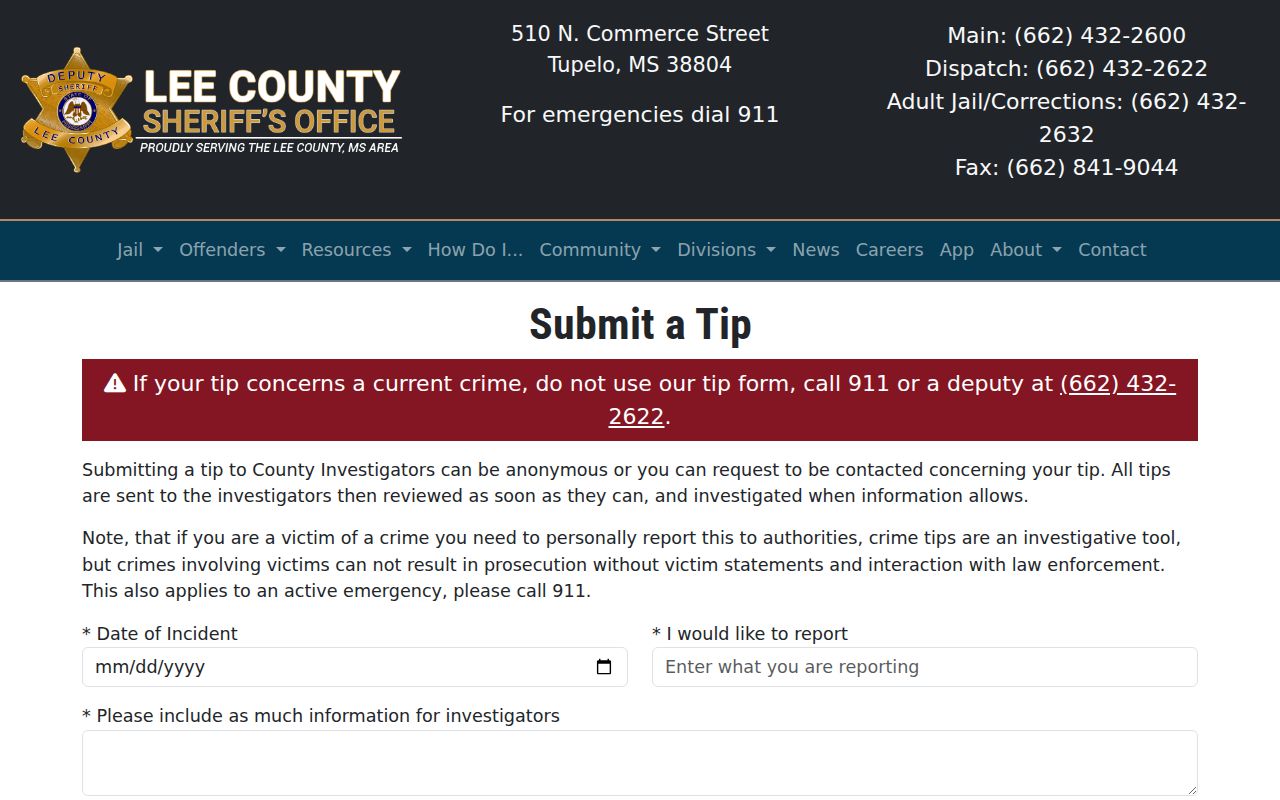
A tip should relay observations, not conclusions. Let the Sheriff, the court, and the case record settle the official result. Include a location, a time, and details that make the information useful. No Lee County reward program has been verified, so do not count on one being offered.